

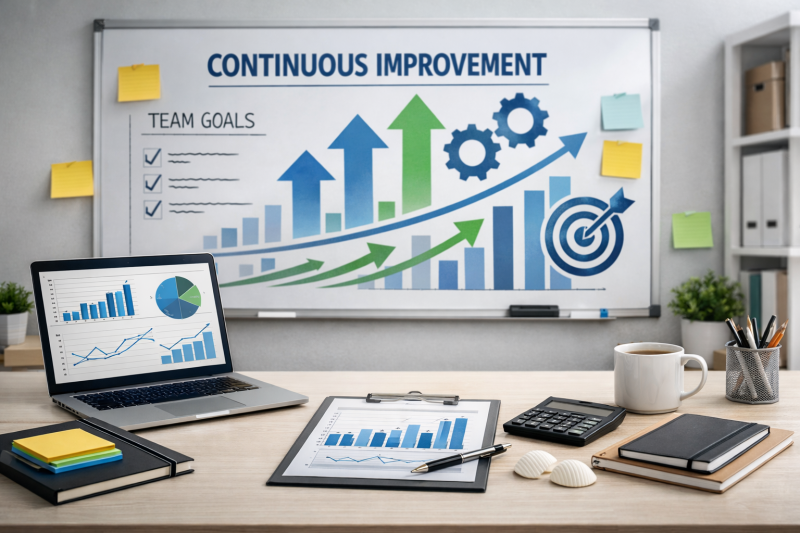
💼 Continuous Improvements in the Workplace
Small changes, big impact — and most of them are already happening without us even noticing.
🌱 Why Continuous Improvement Matters More Than Ever
Every workplace, no matter the industry, relies on one powerful idea: continuous improvement. It’s not a buzzword, not a management trend, and not a one‑off project. It’s the steady, ongoing commitment to making things better — safer, smoother, clearer, faster, and more efficient.
What makes continuous improvement so interesting is that it’s already happening around us. Every shift. Every day. Every time someone says, “There’s a better way to do this,” or “What if we tried it like this instead?” — that’s improvement. And most of the time, we don’t even realise we’re doing it. 💡
In today’s workplaces, where expectations grow, technology evolves, and safety standards rise, continuous improvement isn’t optional. It’s essential. It’s how teams stay confident, how leaders stay informed, and how businesses stay competitive.
🔄 What Continuous Improvement Actually Looks Like
Continuous improvement doesn’t always look dramatic. It’s not about ripping up processes or reinventing the wheel. Most improvements are small, practical, and quietly powerful:
- Adjusting a machine setting to reduce waste.
- Reorganising a workstation to avoid delays.
- Adding a safety check that prevents accidents. 🦺
- Finding a quicker way to complete a repetitive task.
- Sharing a smarter idea with a colleague. 💬
These small changes add up. They build momentum. They create a culture where improvement becomes normal — not forced, not feared, and not complicated.
👥 The Best Ideas Come From the People Who Do the Work
If you want real improvement, you listen to the people who work with the process every single day. They see the delays, the risks, the frustrations, and the opportunities. They know what works and what doesn’t. And their ideas often lead to:
- 🦺 Safety improvements: removing hazards, adjusting layouts, adding checks.
- 💷 Financial improvements: reducing waste, saving time, preventing rework.
- 💻 Technology improvements: using tools or software more effectively.
- 📊 Process improvements: clearer instructions, better communication, smoother flow.
When colleagues feel listened to, they share ideas that genuinely work. When hierarchy supports those ideas, improvement becomes a shared responsibility — not a top‑down demand.

🏛️ The Role of Hierarchy — Asking the Right Questions
Leaders play a crucial role in continuous improvement. Not by controlling it, but by guiding it. Good leadership means asking the right questions before approving or implementing any change:
- What exactly needs to change?
- Why is this change necessary?
- When is the right time to implement it?
- How will we introduce it safely and clearly?
- Who will be affected and how do we support them?
- What benefits will this bring — financial, safety, efficiency, or technology?
Leaders also need to understand something important: employees fear change for real reasons. Not because they’re stubborn, but because change can feel like uncertainty.
People worry about:
- Making mistakes.
- Losing control of their routine.
- Not being able to keep up.
- New expectations they weren’t prepared for.
When hierarchy explains the “what, why, when, and how,” fear turns into understanding — and understanding turns into progress. 🤝
😟 Why People Fear Change — And Why They Don’t Need To
Change can feel uncomfortable, but we’ve already proven we can handle massive change. On 23rd March 2020, during COVID, the world shifted overnight. Workplaces closed, routines changed, and we had to adapt instantly.
And we did. We learned new ways of working, communicating, and staying safe. That moment showed us something powerful:
We are capable of embracing change — even when it’s sudden, unexpected, and uncomfortable.
Continuous improvement is simply a smaller, calmer version of that. Instead of overnight change, it’s step‑by‑step progress. Instead of uncertainty, it’s clarity. Instead of fear, it’s growth. 🌱
📱 Technology — The Perfect Example of Continuous Improvement
If you want proof that continuous improvement works, look at your phone. Technology companies upgrade our devices constantly — new versions, new features, better security, faster performance. These are their continuous improvements.
We don’t always ask for these changes, but we accept them because they make life easier. Workplaces can follow the same principle: small upgrades, steady improvements, and better ways of working. 📲
Just like your phone updates quietly in the background, workplaces can improve quietly too — one update at a time.
🌟 Owning Your Own Improvements
Continuous improvement works best when everyone feels involved. Employees can:
- Identify small problems or delays.
- Suggest practical ideas that make work safer or smoother.
- Implement agreed changes with support from hierarchy.
- Review what worked and what needs adjusting. 🔍
When people see their ideas being used, they feel valued. When hierarchy explains the purpose behind changes, trust grows. Together, they create a workplace where improvement is natural, not intimidating.
Continuous improvement isn’t about perfection — it’s about progress. It’s about making today slightly better than yesterday, and trusting that those small steps add up.
🚀 Continuous improvement is not a project — it’s a mindset. And once a workplace embraces it, everything becomes possible.
Continuous improvements aren’t just for the workplace 💜
Small changes can support us in everyday life too — whether it’s how we spend, plan, organise,
or look after ourselves. The same principles we use at work, like noticing habits and making
gentle adjustments, can help us in all kinds of situations. Even one small improvement can make
life feel a little lighter and more intentional.
Add comment
Comments